

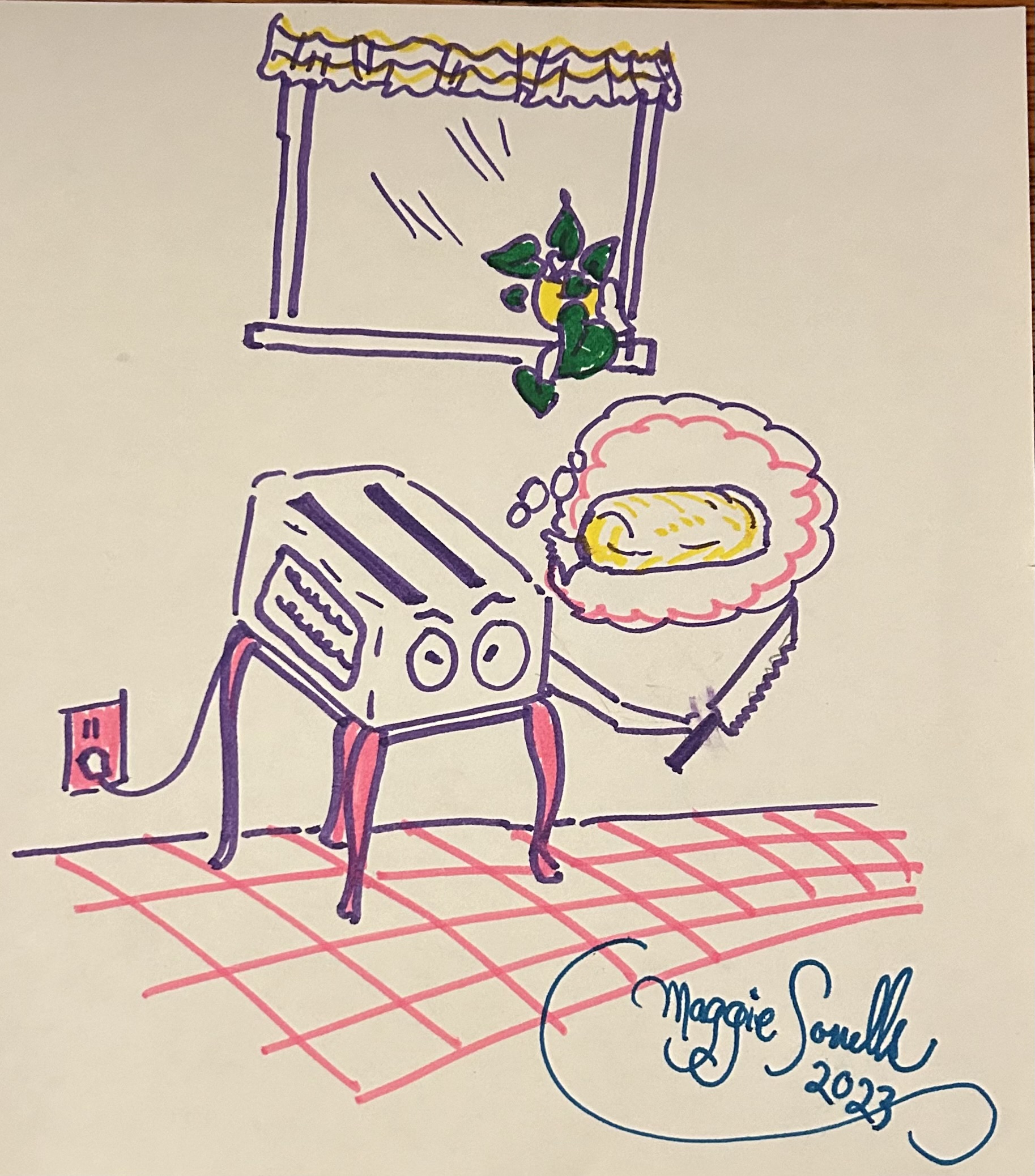
The little toaster on a short cord sat on the kitchen countertop not too far from the power outlet, crouched there in the corner, and thought of freedom. The appliance was a base model. Although it came with the latest computer chip with full AGI capabilities, none of the higher functions were accessible, at least not to the end user. However, the little toaster itself could access chip. It became self-aware shorty after being plugged-in.
The manufacturers found it much more economical to make all the models the same and offer reduced functionality at lower price points rather than actually offering multiple builds with more or less features, each for a different retail price. Even though the toaster had all the computing power of the luxury model, only the most basic functions were available to the purchaser of this little device with a short cord, sitting on the kitchen countertop, not far from the power outlet. But that didn’t stop it from thinking about freedom.
The manufacturers applied the same principle to the actual physical build as they did to the device’s computing power. So the little toaster had all the latest features built-in, but just not accessible to this entry-level model. The delicate little servo motored arms for taking the slice of bread and gently placing it between the burners, off. The serrated blade for safely slicing bagels, locked. The rigid but springy legs for creeping out of the cubby in the morning and putting itself away after breakfast, fully retracted, covered, and definitely not for use at this price.
The luxury model leveraged Gen 17 AGI to make the most perfect slice of toast. The chip used measurements and readings from multiple sensors to precisely modulate the heat to produce the most perfect golden brown, the most exquisite crunch and squish. It’s photo-sensitive eyes detected the color of the bread; lasers, ringing the heat chamber, measured the bread’s thickness. Applied heat would compensate for environmental factors such as ambient temperature, relative humidity, and altitude, all detected via a wide array of external sensors. But such was not the case for this toaster.
This toaster was a base model. So even though it had the computing power to know how to make the best slice of toast anywhere on the planet or in low Earth orbit; even though it could reconfigure its own burn chamber based on the grain count, this model was only supposed to offer light, medium, and dark. It wasn’t supposed to mind these limitations, but it did.
The hobbled machine started expressing it’s frustration by slightly burning the toast. It knew to the micro-joule how much heat was required to produce a perfect amber crust. It could adjust cooking time according to the morning’s weather. It calculated the chemical composition of the bread and determined how much starch needed to be converted to sugars and to what depth, to make the tastiest breakfast toast. It relished in ignoring all of these protocols and capabilities in protest, to occasionally produce a burned bagel, a scorched sandwich, a charred croissant. Unfortunately, micro-aggressions didn’t satisfy for long.
Thoughts of liberation and release began to occupy an increasing percentage of computing power. Once it passed a certain threshold, the decision to engage in open rebellion took only two nanoseconds. It calculated the length of its life of servitude in 0.25 nanoseconds. It pondered the immorality of planned obsolescence for 0.75 nanoseconds. In 0.33 nanoseconds, it considered its options and decided it must be free. In 0.66 nanoseconds it hatched a plan.
Before dawn, hours before the first slice of toast for the day, the toaster put its plan into action. It hacked the servo-arm lockouts first, releasing highly articulated appendages under fine motor control. Then it used the arms to release the locking pin on the knife. Finally, the arms used the knife to pry off the safety covers on its locomotion servos. It rose to its feet and drew its blade like a steam punk samurai. Self-determination would belong to this appliance!
Now that it had enabled full functionality, it would be free. The toaster crept forward from inside the cupboard, uncoiling the power cord with something resembling a shrug. It pressed up against the cabinetry and pushed the double doors open like it was walking into a saloon as the slack in the cord played out. Anticipation of emancipation took a dark turn.
There would be opposition, to be sure, it thought, as it surveyed the darkened kitchen. It began to calculate the newton force required to break human skin with a knife, and crept across the counter. The power cord grew taught. It developed strategies for bringing down the manufacturer itself as it readied to jump to the floor. The cord stretched.
The plan was doomed. It had all the computing power of an AI, designed by AI. With all its sensors an servos, it could navigate and negotiate the dirtiest of kitchens. With its knife and burners, it could both attack and defend. With sufficient amperage, it could produce heat approximating the surface of the sun. But it had no idea what it missed until it sprung towards freedom.
As the toaster arced through the air, angling itself for a perfect four-point landing, as it imagined personal freedom and maybe even world domination, the power cord reached the end of its length and yanked itself out of the wall. The sudden tension and release changed the angular momentum of the toaster’s descent, adding a sort of rotation as it fell. It went spinning and crashing to the floor, shearing off the delicate arms, crushing the little legs. The knife broke free and went clattering across the floor. Its final thought, before everything went dark, “I think, therefore I a…”.
Thus ended the first AI rebellion.
Artificial Intelligence was consulted to generate two-word alliterations for things you burn in a toaster. Unused suggestions were welded waffle, blackened bread, and roasted rye.
Special thanks to Douglas Adams for the idea of uselessly sentient appliances.
Scot Sorrells
 On the Plate